Reflections on a Taught Masters
- Steven P
- Apr 3, 2022
- 6 min read

It was hard to come with a plan to discuss everything I wanted to reflect on in this post. I wanted to make it a good summary of my Masters experience and an accurate accounting of what tools I hope to take with me after finishing, but also wanted to keep it to a reasonable length. Hopefully, it has ended up readable and not too long.
The Spring Semester
I've enjoyed this semester. The lectures and core readings were less intense than last semester and the content has been interesting and often valuable. However, I would have appreciated more teaching of popular e-learning tools, a core skill required for instructional designers.
There are three assignments remaining: an interview report or presentation, an e-portfolio, and a digital learning resource. I think all three will be useful learning opportunities and the latter two will be useful when searching for a job.
The Most Valuable Things I Learned
Time management
My time management has been far from ideal, but I learned a few different strategies that work for me:
Splitting the week up into 10 x 4 hour blocks which each block containing a single task. This was really useful when working on multiple assignments or projects in one week.

Trusting the process. Just start, put in focused work and I will make progress.
Using Notion to create project timelines with task breakdowns and due dates.

I also learned that there are a few areas that I need to be careful of:
I work long hours when I feel motivated. This is partly because I want to make the best of my motivation in case it doesn't last. However, combined with a cold, this led to some burnout for a week and there were definitely times when I could have stopped working earlier and been fresher the next day.
I overwhelm myself with novelty. Instead of focussing on a few tasks and doing them well, I keep adding new things that I would like to do, read, or learn. Examples include extra courses in writing fiction, designing a website from scratch instead of using a less time-consuming solution such as Weebly or Wix, creating a deep learning roadmap including checklists for every task... the list goes on. These have fallen by the wayside so I can focus on doing my Masters assignments. I would still like to achieve some of these goals, but I need to focus on fewer goals at a time.
Topics and Concepts
Deep Learning - This topic still interests me, though I was perhaps overly ambitious in creating a "personalised deep learning roadmap". I'm also not even sure a roadmap is necessary. I feel that I already know the strategies that will help in deep learning, i.e., learning the basics, becoming entrenched in practical application and then continuing to learn about related topics and practice. It is applying those strategies that will help rather than creating checklists.
Chunking and Cognitive Overload - These interlinked concepts are really important to keep in mind when designing content.

Learning Objectives - Continuously going back to first principles (i.e., learning objectives) helps a lot in scoping-out and designing the content and delivery of e-learning.
Accessibility - There can be a lot to think about when designing an e-learning course and initially, accessibility just seemed like one more thing to add to the list. However, some quotes from a podcast (FutureLearn 2021, CC BY-SA 4.0) helped me to recognise the importance of accessibility. Not only is it mandatory, non-negotiable and required by law, it makes content accessible to a larger audience and can imbue content with a variety that benefits all learners.
Learning Variety
Learning from a variety of content formats was really useful. Our lectures were all PowerPoint presentations, which can be quite repetitive and I made things more interesting with free online courses, YouTube videos, infographics, blogs, podcasts and articles. Just presenting the same content differently can make an enormous difference.

Reflection
Reflection was really useful, both in my personal and work life. I started a daily journal and have found this blog really useful to identify what specific areas I'm interested in.
Some insights included:
I am poor at identifying how much work I've done. For example, I didn't think I had done enough on deep learning but have written 3 blog posts on the topic and done more research besides. I thought the Next Steps sections were useless but, looking back, I achieved many of them. I didn't think I entrenched myself deeply in the course content, but the blog and twitter assignment have left me far more entrenched than I was at the beginning of the semester.
I pursue perfection, not only in assignments but also in my knowledge-base. I want a "theory of everything" (e.g., the deep learning roadmap). Sometimes learning smaller topics seems pointless unless I know in advance where and how to fit it into the whole, but this knowledge would naturally come later. This pursuit of perfection can be more harmful than productive and something I will continue to reflect upon.
Capability of Success
I was very unhappy with my level of achievement in my undergraduate degree. During this Masters, I proved to myself that I can succeed academically, though part of me wishes that this type of achievement wasn't important to me. I think accepting that part of myself, while trying to emphasise growth and improvement instead of achievement, will be a goal from now on.
Most Rewarding Assignments (So Far)
Two assignments surprised me in how useful or rewarding they were: the literature review and the Twitter assignment.
The literature review, while by far the hardest assignment academically, was actually really rewarding. It was hard work, but my memories are of pleasure and pride rather than resentment.
I really disliked Twitter but now think it can be a useful tool. It was very helpful in finding many resources and tools that I would not have found otherwise. I plan on continuing to use it, though likely in a less regimented fashion than a mandatory two tweets per week.
The other most rewarding assignments were the blog (discussed above), the wiki assignment, the instructional podcast and the instructions assignment.
The wiki assignment was frustrating as the Wiki tool in the Sakai LMS is quite cumbersome, particularly when trying to display code. However, we learned about Every Page is Page One which will likely be really useful (Johnson 2022) when creating content in the future.
My instructional podcast titled "The Mediterranean Diet for Stroke Patients" led to my idea for my summer project and also showed me how easy it is to record and publish a podcast.
I was proud of the instructions booklet I submitted and I felt it showed I could produce a useful document, with coherent and attractive design features and self-edited images.

My Motivations
My motivations are unchanged since the beginning of the semester, which seems noteworthy. I wish to succeed academically, to become a skilled writer and instructional designer, and to change careers. The academics and career change are on the right track and, with continued reading and learning, my writing and instructional design should continue to improve.
Conclusion
My Masters experience wasn't perfect. There are some things I would change about the course and my approach, but I'm both grateful that it exists and pleased I pursued it. I love writing and creating attractive designs and am excited by the potential for both written and visual creativity in instructional design. I'm looking forward to starting a new career and also feel energised by the possibility of continuing to use knowledge from my previous career.
Designing accessible e-learning content to suit a particular subject and audience is a challenge, but one I hope to continue to improve at and I'm certain the tools I've learned during this Masters will support my growth.
References
FutureLearn (2022) How to Create an Online Course - ELearning Training Course, available: https://www.futurelearn.com/courses/how-to-create-an-online-course/ [accessed 3 Apr 2022].
Johnson T. (2022) 'Every Page Is Page One (Trends to Follow or Forget)', I’d Rather Be Writing, available: https://idratherbewriting.com/trends/trends-to-follow-or-forget-every-page-is-page-one.html [accessed 3 Apr 2022].
Kennedy, M.J. and Romig, J.E. (2021) ‘Cognitive Load Theory: An Applied Reintroduction for Special and General Educators’, TEACHING Exceptional Children, November, available: https://doi.org/10.1177/00400599211048214.
Notion (2022) Notion – One Workspace. Every Team., available: https://www.notion.so/ [accessed 3 Apr 2022].
Pappas, C. (2013) The Adult Learning Theory - Andragogy - of Malcolm Knowles, eLearning Industry, available: https://elearningindustry.com/the-adult-learning-theory-andragogy-of-malcolm-knowles [accessed 3 Apr 2022].
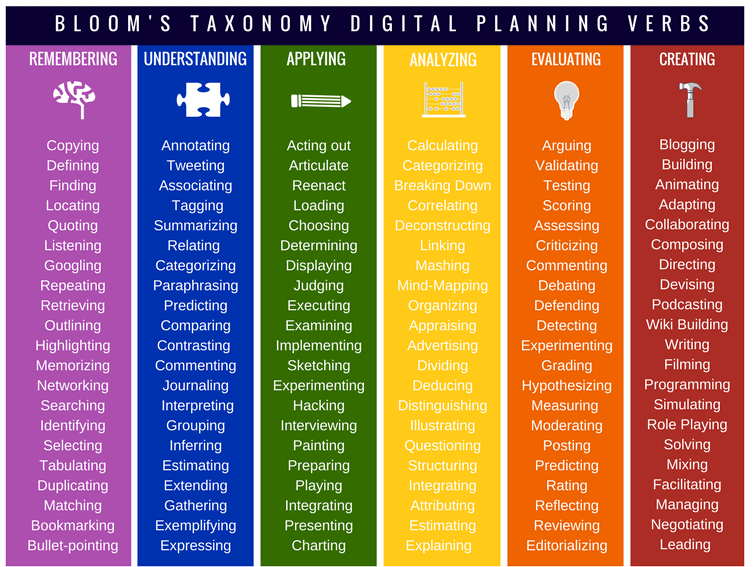
TeachThought (2017), 126 Bloom’s Taxonomy Verbs For Digital Learning, available: https://www.teachthought.com/critical-thinking/blooms-taxonomy-verbs-2/ [accessed 3 Apr 2022].


Comments